8 min readArrow Industries
Choosing a Monoblock Pump Casing: What to Look For
A pump casing has to hold pressure, present a true sealing face, damp vibration and machine cleanly — all from one casting. What to look for in a self-priming monoblock casing, and why grey iron is still the default.
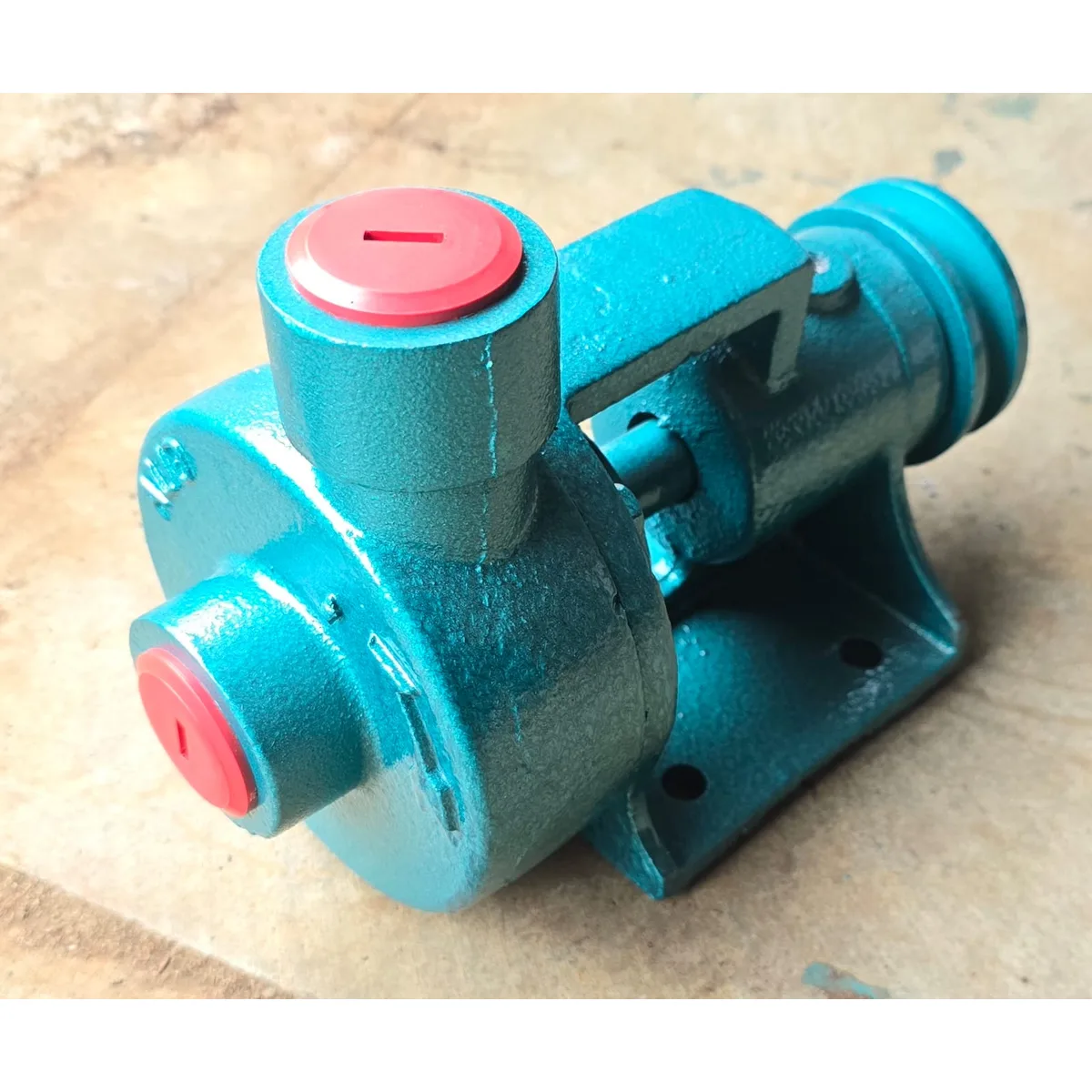
A monoblock pump casing is a pressure-containing casting with machined sealing faces, and it has to do several things at once that pull in different directions. Getting it right is mostly about soundness and machining, not about exotic material.
What the casing actually has to do
- Contain pressure without weeping through the wall
- Present a true sealing face so the cover and the mechanical seal sit square
- Hold the hydraulic passage shape closely enough that efficiency is not thrown away
- Damp vibration from the rotating assembly
- Machine cleanly at the faces, bore and mounting feet
A casting that is strong but porous fails at the first. A casting that is sound but distorted fails at the second. Both are rejected for the same reason: the part does not seal.
Why grey iron is the default
Grey cast iron to IS 210 remains the standard material for this part, and not for want of alternatives.
- Damping. Flake graphite absorbs vibration. A cast iron casing runs quieter and transmits less into the mounting than a fabricated or pressed equivalent.
- Machinability. Graphite acts as a chip breaker. Sealing faces and the seal bore come out cleanly and cheaply, which matters when they must be flat and square.
- Compressive strength and stiffness. The casing is largely in compression and hoop stress, which is the regime grey iron is good at.
- Castability. It fills the volute and passage shapes with modest shrinkage, so the hydraulic form is repeatable.
- Cost. At quantity, nothing else comes close for this geometry.
The grade follows the pressure duty — the trade-off between FG 200 and FG 260 is set out in FG 200 vs FG 260.
What goes wrong, and what it looks like
| Problem | Cause | Symptom in service |
|---|---|---|
| Porosity through the wall | Section not fed as it solidified | Weeping under pressure, usually at a thick section |
| Distorted sealing face | Uneven cooling, or machining before stress relief | Seal leaks; face will not sit flat |
| Rough passage surface | Mould finish, sand inclusion | Lower efficiency, more turbulence |
| Hard spots | Too-rapid local cooling | Will not machine cleanly; tool chatter at the face |
| Wall thickness variation | Core shift in the mould | Thin side is the pressure weak point |
Note that four of the five are process problems, not material problems. Specifying a higher grade does not fix any of them.
Self-priming casings in particular
A self-priming pump carries a reservoir volume in the casing so it can clear air from the suction line without being primed by hand each start.
That makes the casting bigger and more complex, with a larger internal cavity and more section change — and more section change means more opportunity for shrinkage where the metal feeds last. The feeding and gating design matters more on a self-priming casing than on a plain volute, which is why they are not simply a scaled-up version of the same part.
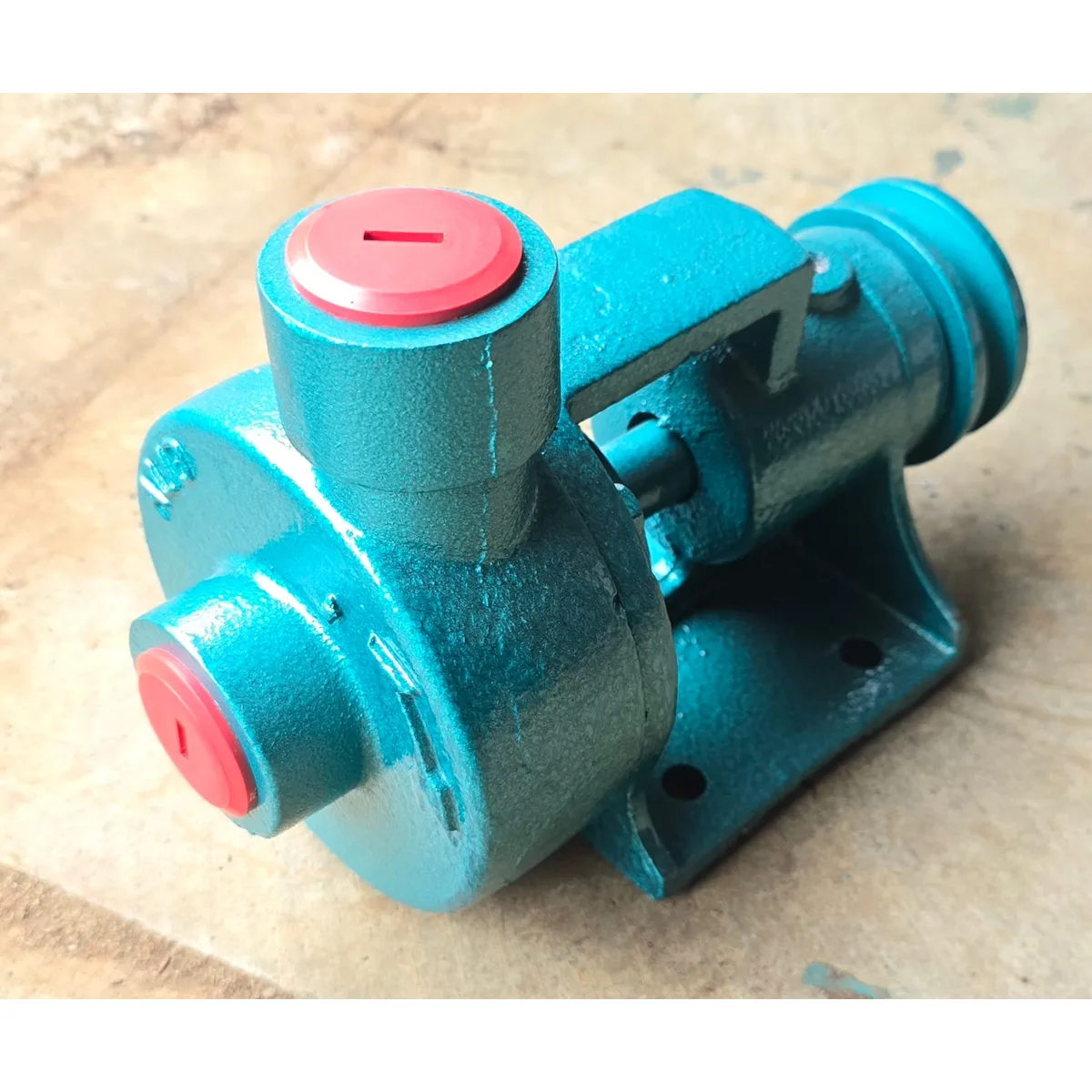
Our self-priming monoblock pump casing is poured in 0.5 to 2 HP frame sizes.
What to ask a foundry
- Is the casing pressure tested, and at what pressure? This is the only direct check for porosity through the wall. Ask to see it, not just be told about it.
- Where does this casting solidify last, and how is that section fed? A foundry that can answer is controlling shrinkage deliberately.
- Is machining done after stress relief? Machining a casting that has not settled gives a face that moves afterwards.
- What is the wall thickness tolerance, and how is core position controlled? Core shift is what produces a thin side.
Bare-shaft versus monoblock
A monoblock integrates pump and motor on a single shaft in one assembly — compact, fewer alignment problems, less to go wrong on installation.
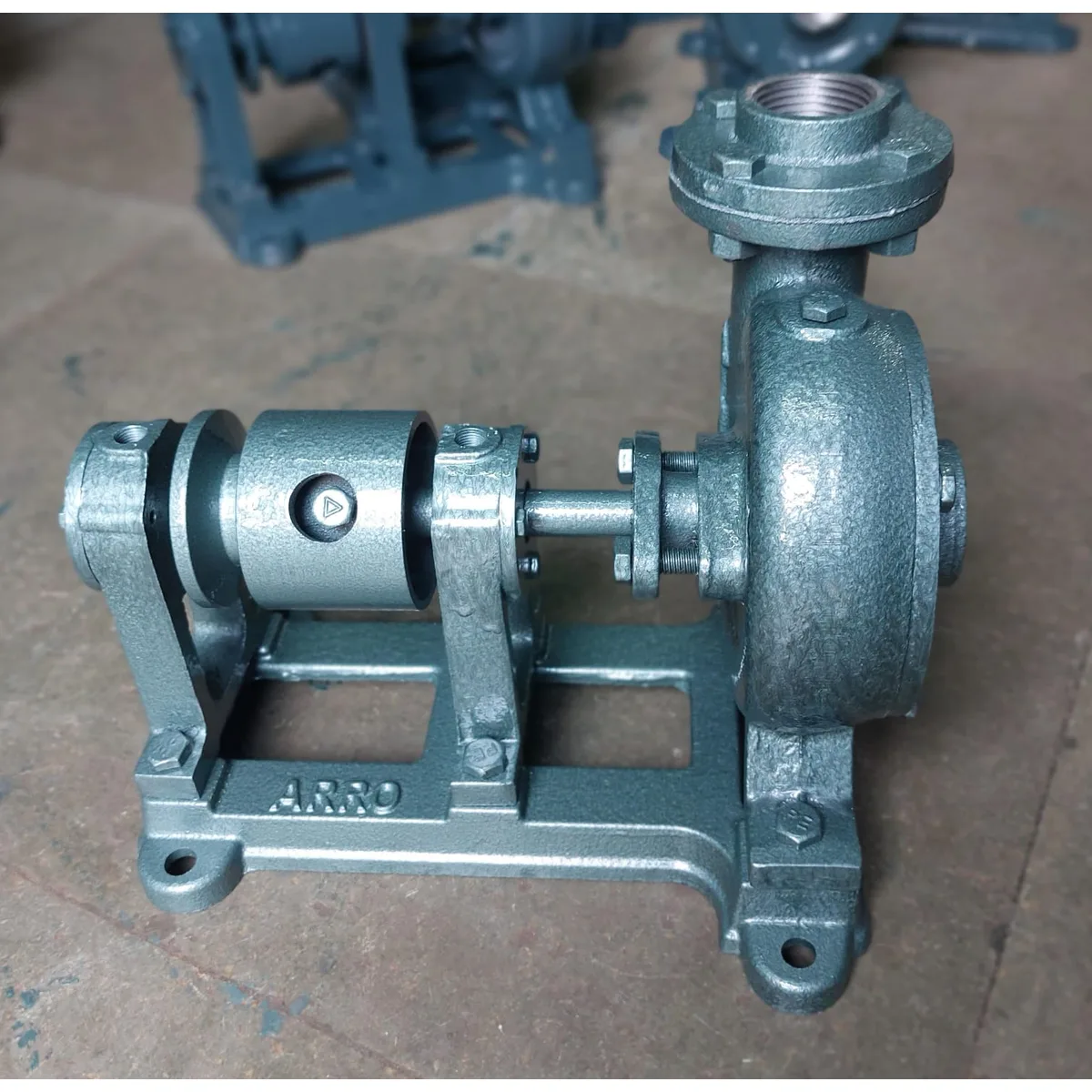
A bare-shaft pump is supplied without a motor, on a base frame, to be coupled to whatever drive the application calls for — an electric motor, a diesel engine, a tractor PTO. It is the choice where the drive is not a standard electric motor, or where motor and pump are serviced on different cycles. Our bare-shaft centrifugal pump on a CI base frame covers 2"×2" through 4"×3".
The base frame is a casting that matters more than it looks: it holds the alignment between pump and drive, and a frame that flexes puts the coupling out of line every time load changes.
Frequently asked questions
What material is a monoblock pump casing made of?
Grey cast iron to IS 210 is the standard, in FG 200 or FG 260 according to the pressure duty. It damps vibration, machines cleanly at the sealing faces, is strong in compression, and casts the volute shape repeatably.
Why do pump casings leak?
Most often porosity through the wall, where a section was not fed properly as it solidified, or a sealing face that has distorted because the casting was machined before it had stabilised. Both are process problems rather than material problems.
What is a self-priming pump casing?
A casing carrying a reservoir volume that lets the pump clear air from the suction line without being primed by hand at each start. The larger cavity and greater section change make feeding and gating design more demanding than on a plain volute casing.
What is the difference between a monoblock and a bare-shaft pump?
A monoblock integrates pump and motor on one shaft as a single unit. A bare-shaft pump is supplied without a motor, on a base frame, to be coupled to an electric motor, diesel engine or PTO drive as the application requires.
Should a pump casing be pressure tested?
Yes. It is the only direct check that the wall is sound and will not weep under working pressure. Ask for the test pressure and the result rather than taking soundness on trust.
Does cast iron damp vibration better than fabricated steel?
Yes, substantially. The flake graphite in grey iron absorbs vibration, which is why pump casings and machine bases are cast rather than fabricated. It is one of the main reasons the material is still the default for this part.